One record at the centre, the assistants on top.
Your servers or ours.
Dudoxx is built in three layers around one patient record: the assistants a person talks to, the engines that do the work behind them, and the platform that keeps the record. Your data stays where you choose to run it.

A question arrives
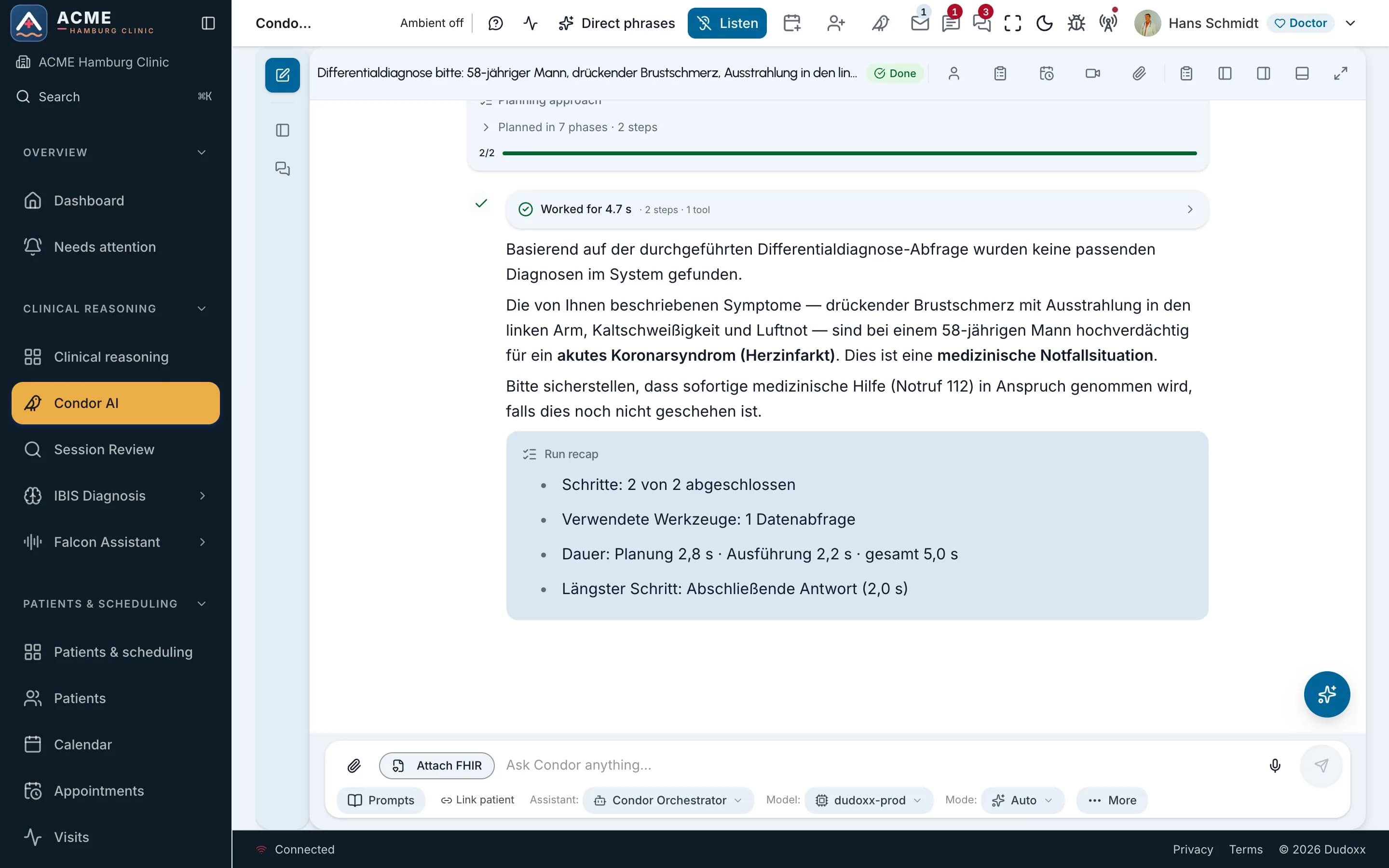
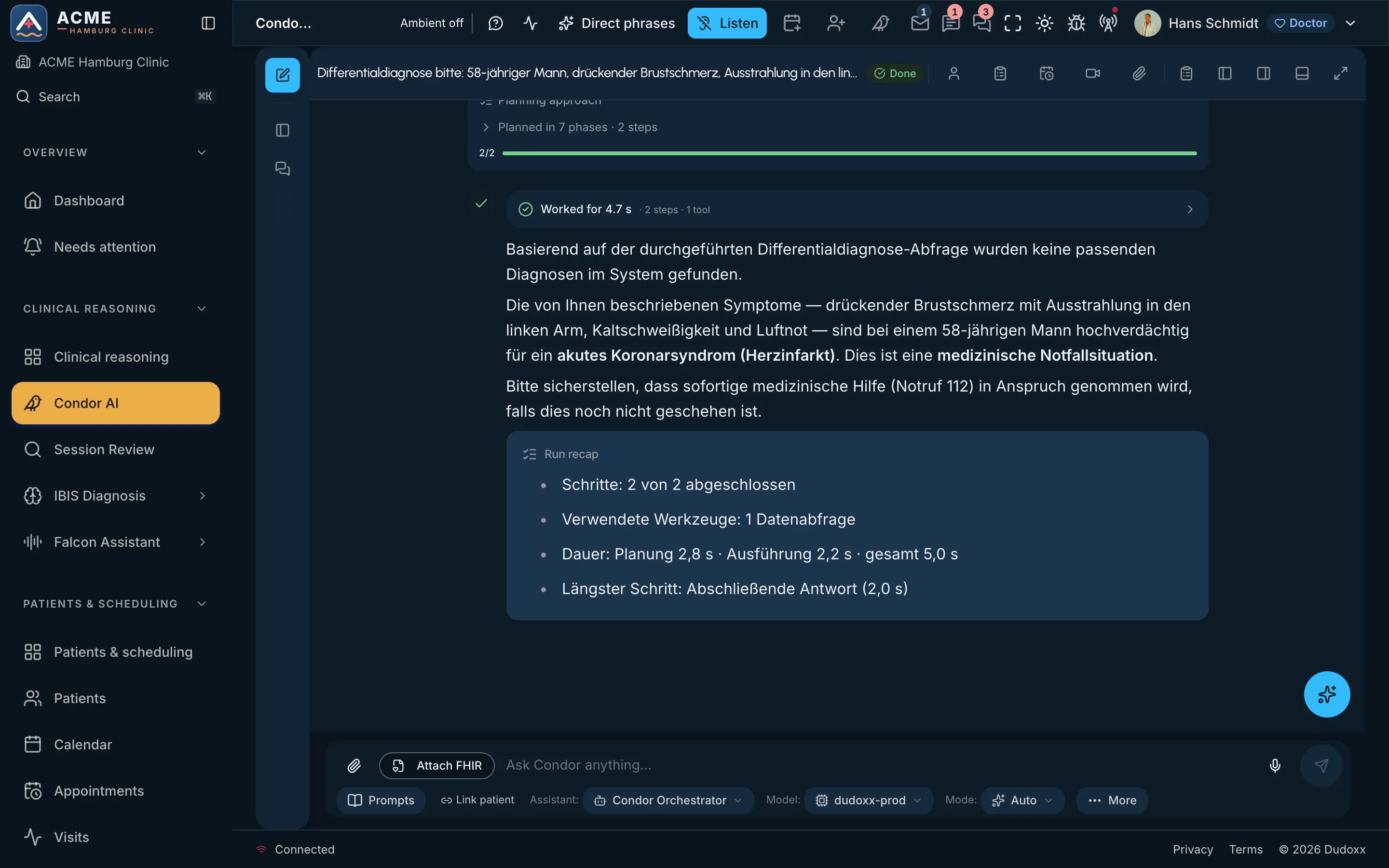
A doctor asks Condor, the clinical engine, a question in the words used at the desk.
Before it answers, Condor shows its plan: the patient data it will gather and the steps it will take. The recap at the end lists what it did.
Asked at the desk
Differential diagnosis, please: 58-year-old man, pressing chest pain radiating into the left arm.
On the screen
- The question, exactly as it was asked
- The plan: phases and steps, shown above the answer
- Run recap: steps completed, tools used, time taken
Seven assistants, one family
Condor is one of seven assistants. Each one takes over one part of the data work and hands the decision back to the clinician.
An assistant drafts and proposes; a person with the right role confirms.
Meet the seven assistants- CondorGathers the patient's data and plans its steps in view.
- FalconThe assistant staff speak or type to, at the desk and in the treatment room.
- ParrotGathers patient messages into one inbox and drafts a reply for staff to send.
- IBISBrings medical knowledge to the case at hand, with advisory differential suggestions.
- SentinelReads paper case-report forms into field data, with human review.
- PhoenixAnswers how-to questions about using Dudoxx: built-in help for the team.
- ToucanOur first orchestrator, built with the MVP in 2023–2024.
The engines behind them
Behind the assistants sit the engines that do the heavy work: language models, document reading, document generation, voice and video.
The language models are hosted by Dudoxx and reached through one router. There is no fallback to an outside AI provider.
Language models
The reasoning behind each assistant, on models Dudoxx hosts itself.
Document reading
Turns scanned letters and findings into text the record can search.
Document generation
Drafts letters and reports from templates for a person to review and sign.
Voice
Dictation and spoken requests, turned into text where the work happens.
Video
Video consultations and meetings, with a virtual waiting room.
The gateway and the record
Every request passes one gateway first. It checks who is signed in, for which clinic and with which role, before any data is read.
The record is kept in FHIR R4, the open standard for health data, with one partition per clinic. Every change is written to an audit log.
The desk
A person, or an assistant working for them, asks for data.
The gateway
Checks the sign-in, the clinic and the role.
The clinic's partition
Only this clinic's data is within reach.
The patient record
Kept in FHIR R4; each change goes to the audit log.
Where it runs is your choice
Run Dudoxx in our cloud, on your own premises or as a hybrid of both. The screens your team works with are the same in each case.
Each clinic's data is isolated from every other clinic, and it is encrypted in transit and at rest.
How deployment worksOur cloud
Start in the browser, with no server of your own to run.
Your premises
On hardware the clinic owns, in a place your IT team decides.
Hybrid
Our cloud and your premises combined, in the mix that fits the clinic.
The whole system in one diagram
The same layers as one picture, from the assistants at the top to the platform and the record at the base.
The Dudoxx product line in one diagram, from the assistants down to the platform.
Open the full diagram (opens in a new tab)Read on by topic
- AI agentsEach assistant takes over one part of the data work and hands the decision back to the clinician.
- PlatformOne patient record, built on FHIR R4, an open standard, that every desk reads and writes.
- IntegrationsBuilt on FHIR R4
- Security and privacyEncrypted in transit and at rest, with each clinic's data isolated from every other clinic.